
McKinley County Sex Offender Checks
The New Mexico Department of Public Safety Law Enforcement Records Bureau manages the New Mexico Sex Offender Registry through OffenderWatch. McKinley County Sheriff's Office registers covered residents and enters their changes into that state chain. The public interface is the main local lookup because the research found no separate McKinley County sheriff registry map or list.
Begin with the state registry and filter by McKinley County, a name, or a known place. Use a place search when the goal is awareness around an address. Use a name search only with enough details to distinguish people. Address and status data can change, so a result should be read with the registry's current disclaimer and update information.
McKinley County Registry Chain
New Mexico's registry works through two linked custodians. The state Sex Offender Registry Unit manages OffenderWatch and transmits data through national justice systems. MCSO handles local registration and compliance entry for covered people living in McKinley County. This explains why a statewide profile may show McKinley as the registering county even though the public search is hosted through NMDPS.
The state unit also translates tribal, federal, military, foreign, and out-of-state convictions to the closest New Mexico offense. That legal classification can affect the required frequency and duration. It should not be guessed from the short offense label shown to the public. For a registration or compliance question, call MCSO at 505-863-1410 and ask for the Sex Offender Registration Unit's current appointment location and hours. State program questions may go to 505-476-2444 or dps.sorna@dps.nm.gov.
Weekly reminders sent by the state are part of the administrative chain, but the public profile does not expose the full compliance file. MCSO may hold facts that are not suitable for public display. A resident who spots a mismatch should give the sheriff the public profile details and the concern, then let the responsible office test it against the official registration record.
New Mexico Sex Offender Registry Searches
The NMDPS Law Enforcement Records Bureau provides the official route to OffenderWatch. Vendor sessions and labels can change. The controls documented during research support name, address, city, ZIP, county, radius, map or list views, and an optional alert function when enabled.
- Open the registry from the NMDPS hub and read the conditions placed on public use.
- Search by name, or use an address, city, ZIP, and county to review a place.
- Switch between the result list and map, then compare enough profile details to avoid a mistaken match.
- Open the full public profile and review the registering county, offense, status, address, and stated registration terms.
| Field or control | Type | Required | Use |
|---|---|---|---|
| Name | Text or mode | Optional | Person search by last and first name. |
| Address | Text | For radius mode | Street, city, or ZIP geocoding. |
| City or ZIP Code | Text or dropdown | Optional | Narrows the area. |
| County | Dropdown | Optional | Select McKinley. |
| Radius | Dropdown | Optional | Exact distances depend on the live vendor setup. |
| Map or List | View controls | No | Changes the result display. |
| Email alerts | Signup | Optional | Address-based notice if the feature is enabled. |
McKinley County and National Registry Results
McKinley County includes extensive Navajo Nation and Pueblo lands, and the county sits within a region where state, tribal, and federal jurisdiction can overlap. A state-only search may not be the last useful layer. The U.S. Department of Justice National Sex Offender Public Website searches participating state, territorial, and tribal registries from one official gateway.
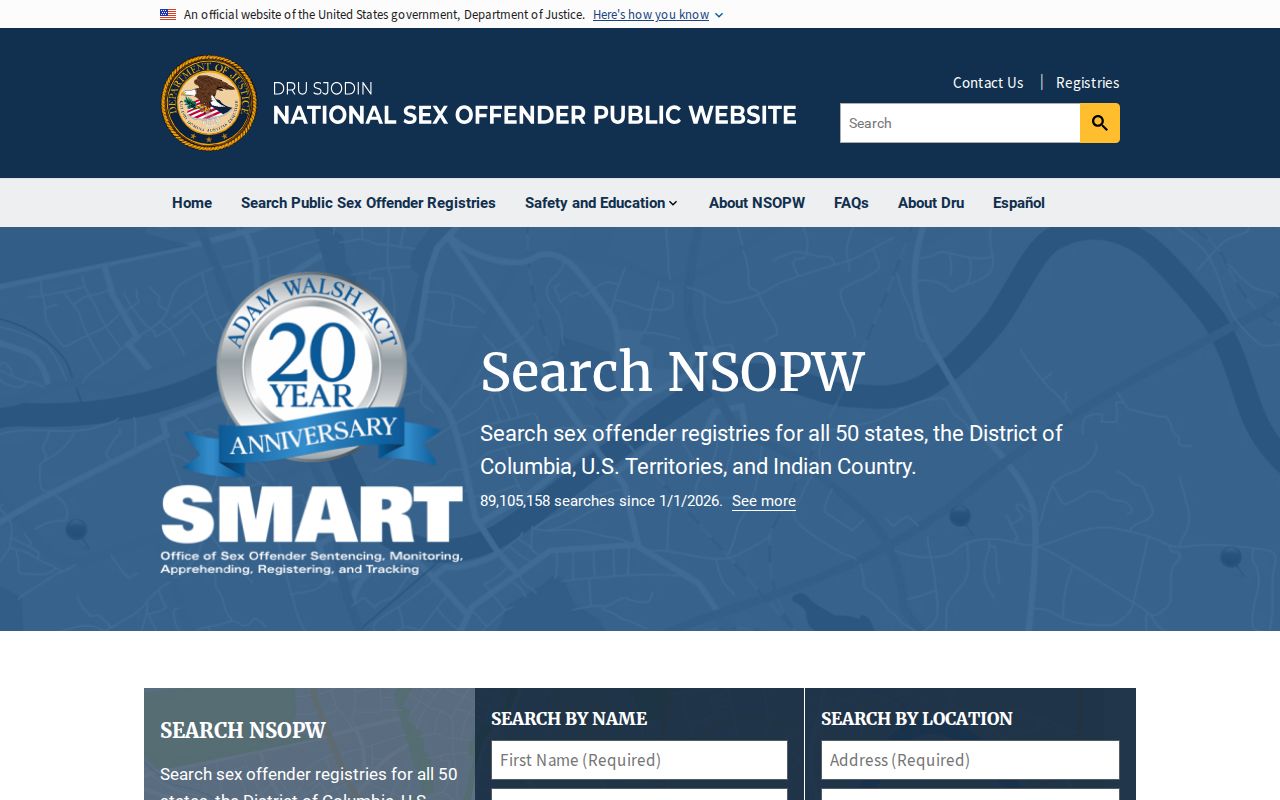
The national search is a cross-jurisdiction supplement, while OffenderWatch remains the direct New Mexico source.
Run both searches when a location lies near a jurisdiction boundary or when a person may have registered elsewhere. Coverage still depends on the records that each participating jurisdiction makes public. A missing result should never be treated as proof that no duty, case, or sealed matter exists.
Registry Profiles: What They Show
A public McKinley County profile is designed for notice and identification. It can show more physical and location detail than an ordinary court index, yet it does not reproduce the prosecution file. No named registrant or profile image should be reused as an example.
| Name and Aliases | Public identity names used to help distinguish a matching person. |
|---|---|
| Photo and Description | Authorized photos plus sex, race, height, weight, hair, eyes, scars, marks, or tattoos. |
| Registered Address | Residence and map information made public under the governing law. |
| Offense and Statute | Description, jurisdiction, conviction date, and statute where released. |
| Registration Terms | Duration and verification frequency associated with the governing classification. |
| Registration Status | Registering county and compliance status, plus other public status details. |
| Other Public Details | Vehicles or authorized work and school locations where the statute permits release. |
Age or birth information can help prevent a false match. Still, users should report a suspected error instead of drawing conclusions from a partial field.
McKinley County Registry Law Source
The public program is grounded in New Mexico's Sex Offender Registration and Notification Act, NMSA 1978 §§29-11A-1 et seq. The New Mexico Compilation is the place to check current statutory text before relying on a registration period or deadline. The public list is limited by statutory scope and may not show every person with any historic sex-related adjudication.
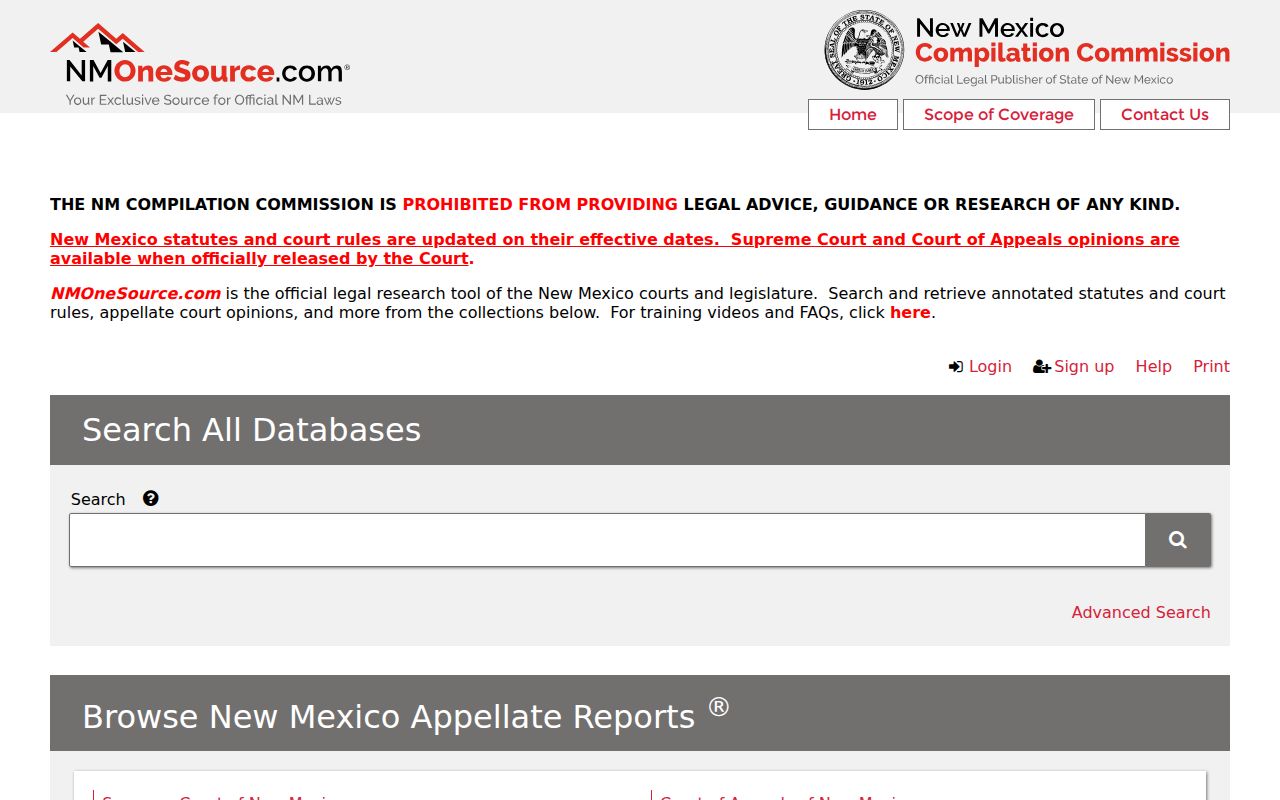
The legal compilation supplies the current rule, while an OffenderWatch profile shows the public record produced under it.
New Mexico law has used offense lists and 10-year or lifetime categories. An unsuccessful 2026 proposal used a three-tier framework. The offense date, conviction jurisdiction, later enactments, and current statutory text can all matter. Readers should not assign a tier by analogy.
Registration Levels and Duties in New Mexico
New Mexico House Bill 199 proposed the framework below in 2026. The official legislative status now lists the bill as died after action was postponed indefinitely, so these periods did not become current law through HB 199. Check the current text of NMSA §§29-11A-4 and 29-11A-5 before stating a duty for any McKinley County registrant.
| Tier described | Duration described | Verification described |
|---|---|---|
| Tier 1 | 15 years | Annual |
| Tier 2 | 25 years | Every six months |
| Tier 3 | Life | At least every 90 days |
The same limit applies to the bill's proposed three-business-day registration language and repeat-conviction rules. The official HB 199 text documents the proposal shown below.
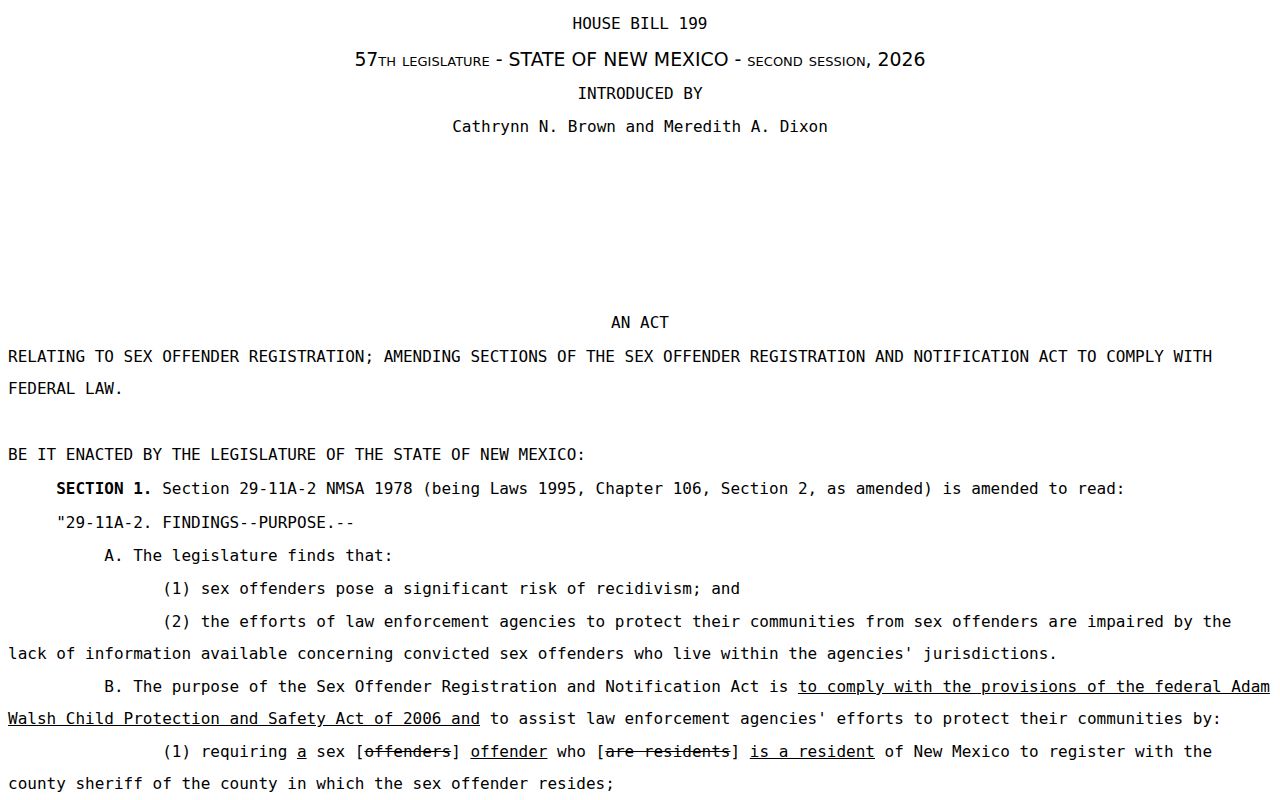
The official bill status lists HB 199 as died, so this legislative record supplies historical context rather than the rule now in force.
Outdated McKinley County Registry Addresses
An address can change after a move, a new registration event, or an agency update. If a McKinley County registry location looks stale, first read the profile's status and update fields. Confirm that the map pin and the text address refer to the same result. Do not visit the location or contact a household to test the entry.
Report suspected noncompliance to MCSO at 505-863-1410. Give the profile identifier, public address, observed issue, and the date the concern arose. The sheriff can compare the report with nonpublic compliance data and state records. Use 911 only for an immediate safety emergency. State program questions can be sent to the NMDPS Sex Offender Registry Unit.
Note: A public report is a lead for trained officials, not a finding that a McKinley County registrant violated a duty.
McKinley County Registry and Supervision
A registry listing and a probation or parole record serve different roles. OffenderWatch provides public notification under registry law. The New Mexico Corrections Department handles adult probation and parole, and its search can show state custody or supervision. Neither product replaces the sentencing order in the court file.
The New Mexico Parole Board addresses parole decisions and hearing information, while NMCD's Probation and Parole Division administers community supervision. McKinley County lies in Region I.
The parole source is useful only when supervision is part of the record and should not be read as a registry profile.
The NMCD policy index includes offender records, violations, absconders, and public-record release policies.
Corrections policy helps define supervision records, which remain separate from McKinley County public registry notice.
Using Registry Information Lawfully
McKinley County registry information supports personal, family, and community safety. It may help residents understand public notices, choose safe contact practices, or share a good-faith concern with law enforcement. It does not prove current danger, predict conduct, or supply a complete criminal history. The public should use the least intrusive action that addresses a real safety need.
Do not harass, threaten, intimidate, unlawfully discriminate against, or engage in vigilantism toward a registrant or household. New Mexico's registry authority appears in NMSA 1978 §§29-11A-1 et seq.; threats, harassment, trespass, assault, and other misuse may be crimes under the laws that govern those acts.
Registry misuse warning: Misusing McKinley County registry information to threaten, harass, intimidate, trespass, or commit another unlawful act can lead to criminal consequences. Report concerns to MCSO, not through public confrontation.
For cross-state awareness, use the official national search. For a suspected local compliance issue, contact the sheriff. For the underlying charge or disposition, consult the McKinley County court case lookup, since the registry is not a substitute for a judicial file.
Personal safety steps should focus on conduct and verified facts. Keep children informed in age-appropriate terms, use normal home and online safety practices, and call the proper agency when a real concern arises. Do not publish a copied profile, circulate a claim that goes beyond the registry, or pressure other people to confront a listed person. Those acts can spread old data and interfere with a lawful compliance review.